Showing posts with label South Bend. Show all posts

Friday, January 17, 2025

Lost Nerve…It’s not a Fake Joke Dumb Band…It’s the Future! (Interview)


The Grand Scheme Despite trying to connect musical dots, I cannot pinpoint this trio’s sound. I can definitely appreciate their straightforward approach, but cannot quite interpret its enigmatic orientation, which makes it all the more alluring. The verses are crammed to the hilt with both quotidian and weighty matters before ascending the heights of stacked choruses. In short, there’s a lot going on under the hood making for a cohesive listening experience.

Rakish Posi-Core!?! At times, the lead vocals remind me of Handsome Dick Manitoba of the Dictators, while the music sounds aligned with the Marked Men. Add in some Rice, Riverboat Gamblers, Chargers Street Gang and even early Epitaph to the aforementioned alliance and what results is an industrial grade alloy of parameter-pushing punk–made to withstand life’s school of hard knocks.

Can we turn the ship around?

The EP’s pièce de résistance is “Busted Seams,” where a searing, but economical guitar solo soars above a low-riding bass chassis that rattles like an alarm clock on an uneven nightstand. The scathing lyrics throughout the EP are sung with anthemic conviction with the words effectively expressing the egalitarian ethos and divergent thought process of punk. The determined lyrics encourage not only a commendable “think for yourself” and DIY approach to life, but ultimately spurs consideration regarding how we treat and support others.


(Responses submitted by Jason Subordinate (JS) - lyrics and vocals; Stiff Mandible (SM) - bass; Theo Dorke (TD) - guitar, drum programming, backing vocals)


This music project seems somewhat shrouded in mystery. Tell us about the origins of Lost Nerve and who was the prime mover behind the formation of this group?

TD: I believe it started right after Stiff and I had released our debut LP from another project that we had recorded and mixed remotely, all on our own, largely during Covid. Jason approached me after asking, if the virtual band dynamic was viable, could we do something together? (We’re all in different parts of the country.) I was absolutely for it and started writing some throwback straight-ahead type songs, which were a fun diversion from the weirdness the other project aspired to. We invited Stiff to join up at some point to add some musical credibility to the endeavor.


How did your past relationships (musical or otherwise) factor in and shape the identity of this EP?

TD: Stiff and I talk about this a lot, that at this stage in our lives, it’s most meaningful and enjoyable to create and play music with friends who we hold dear. I’ve known Jason since high school, and Stiff since first year of college, so the bonds run deep already. Our separate college-days musical acts played shows together, but this coming together from those past connections is new and felt immediately cohesive, like it was waiting to happen, or maybe should have happened a lot earlier! 

SM: I agree with TD on all counts. Making art with friends is one of my favorite things to do, especially when it involves noise and mayhem. And this particular project seemed like a natural evolution of our musical experiences and friendships together.

What are the drawbacks and benefits of being a long-distance recording act?

TD: The obvious drawbacks are that we can’t be in the same room together to jam and collaborate. We can’t gig, or even take a band photo together. Is there a benefit of being structured this way? We as a long-distance “virtual” band benefit from the technology that makes this setup possible. 20 years ago we’d have had to send a 4-track tape through the mail or something, it would have been a lot harder to pull off. This EP was manufactured largely with minimal recording equipment, Dropbox, and a laptop. Maybe the overall benefit is that we do still get to create music together in spite of being separated by great distances, thanks to technology readily available today. 


JS: Yeah, it’s a bummer to not be in the same room recording (or even rehearsing) together. The timespan between “What do you think of this?” and feedback from your collaborators is excruciatingly long. Even after I made TD wait for years before I got my act together, as soon as I sent back recorded vocals, I couldn’t stand waiting to hear what he thought. Still, like TD said, none of this would have been possible without the tech, so we take the bad with the good?  SM: I feel this pain acutely, especially when I’m the one causing it, by usually being the last person to add the necessary overdub to finish the recording phase and move forward with mixdowns. 


What are some of the musical inspirations for this release? 

JS: It’s been fascinating hearing folks contextualize Lost Nerve according to what they know. Some of the comparisons are to bands I haven’t listened to in decades, but they’re all valid. I told TD I just wanted to make some straightforward rock & roll with him, and he obliged with early guitar and drum tracks that got us off and running. As for inspiration, my pedestrian tastes lean toward catchy punk rock and hardcore. (I cut my teeth on the Lookout! Records catalog and mid-nineties Midwest hardcore.) I can’t speak for them, but my impression is that both TD and Stiff draw from more diverse interests and tastes. The end result is something that’s uniquely Lost Nerve!


SM: This whole project was refreshing and fun, compared to my usual trying-to-make-things-too-weird approach. 


TD: When I started writing these songs, there was no notion of, “we want it to sound like this or that,” compared to some other projects that definitely have that focus. It was more about just cutting loose and seeing what came out. I initially thought the riff in “In The Stars” felt like a nod to “Cherrybomb” by the Runaways, but that is as close to an association as I’ve been able to make. Like the boys have stated, it’s interesting to see the connections others have drawn, most have been unexpected and surprising.


I detect some Art Chantry influence in your visual presentation. Would you like to elaborate further on the graphics?

TD: I’m absolutely a big fan of the Chantry aesthetic. I’ve got a couple of his books and a stack of records he did the cover designs for. It felt like an appropriate vibe to nod to when designing the cover for the EP, given that musically maybe we harken to that throwback '80s or '90s raw punk sound. I wanted the art to feel like it would sit alongside other records from that era, with the (yes, Chantry-esque) DIY pasted together and photocopied production process. As far as the image goes, the Hulk has been a favorite comic book character for me since childhood, so using the image of Bixby/Banner from the old TV show, losing his cool (losing his nerve?) and about to Hulk out, was appealing. 


What kind of gear and effects do you use to achieve the particular guitar tones that go from gnarly growl to a full-on swarm of bees?

TD: Given that some guitar parts were recorded maybe months or a year apart, the setups changed a lot throughout the process, switching amps and pedals. I’m not really a gearhead, so it was basically whatever worked alright at the time. For distortion, I’m sure I used RAT, as well as definitely favoring a budget Klon clone pedal, the Mosky Silver Horse. Probably applied some in-GarageBand effects as well during mixing. Same guitar on everything, though… the Crestline Les Paul ('70s Japan-made, lawsuit-era knockoff) that I got at a South Bend pawn shop in the '90s. SM: I play my standby 1990 American Fender Jazz Bass. I also have a 2003 Rick 4003 bass that I sometimes use (it’s sentimental), but for Lost Nerve it was all Jazz Bass.  I used only the Tech 21 DP-3X Dug Pinnick SansAmp Distortion pedal as a preamp directly into the recording interface, using GarageBand to record.

Is the reference to the “Wave! The! White! Flag!” in the song “White Flag” alluding to ceasefire or surrender? JS: It’s definitely about surrender. “White Flag” is a response to the kind of mentality that led to the January 6 insurrection. Honestly, three out of the five tracks on this first EP are a reaction to the socio-political environment we’re all living in right now. “You walk real tall in a world so small” speaks to the outsized confidence we saw (and frankly, continue to see) from people whose worldview is incredibly narrow. I’ll admit, I even had a narrow worldview heading into the election, and I had to reflect on these songs after we saw how the election went. It was dispiriting, for sure, but I think there’s still validity and hope in these lyrics. “Not Down, Not Out” reminds us that our fight for human dignity—that we’re far better when we’re taking care of one another—is timeless.  “It’s Our Turn” can be read as a nod to the Harris campaign and the hope I felt in the idea that we might finally be ready as a nation to elect a woman of color as our president. It’s a call to action and commentary on how the political pendulum swings throughout history and how it is our turn to seize the narrative. Of all the songs on this album, this one stings the most for me after the election, but I also see it as a reminder that we can enact change daily, be it in our homes, at our jobs, or in our communities.   

…

Do you wish to disclose some of the obstacles that had to be overcome to make this release possible? Any lessons learned or insights gained you would like to share?

JS: I’ll take this one, since I was a multi-year bottleneck for us getting this across the finish line. I was envious of all the fun TD was having with his other bands, and since he and I never had a chance to play together back in the day, I said we should do something together. TD was on board right away, and by the time we decided on Lost Nerve for the name, he had written a bunch of songs for me to write lyrics to. It took me forever to get in the right headspace to write lyrics, and I probably wrote lyrics for all of these songs three times before landing on what we recorded. I honestly couldn’t get out of my head and lacked the confidence to just go with it. I think part of it has to do with how social media has really messed with our perspectives. I heard a journalist talking recently about how he was always thinking about how the internet was going to respond to what he wrote—which is a terrible position from which to create media of any kind. Anyway, TD was so supportive and gave me the space to finally get where we landed. We also committed to each other that we were going to finally get something recorded the year he and I both turned 50, so the ticking clock helped light a fire under me. 


Any plans to play live? If so and as an Austin-based band, would the group consider playing at SXSW?

TD: I’m the only one based in Austin. In truth we are an Austin/Toledo/DC-area outfit, collectively. No immediate plans to play live, SXSW or otherwise. It’d be great, though, to converge somewhere, sometime in the future, to rock these songs out on stage together. 


JS: Yeah, I remembered pretty quickly how much playing live was a part of what I loved about being in a band back in the day. Even practice was a chance to let it rip. It’s not the same when your audience is a laptop, that’s for sure. From my perspective, I’ll have my flight scheduled and bags packed before either TD or Stiff finished asking if we want to play a show. 

SM: Yes, we are playing a live show, somewhere, in 2025. right, guys?


What’s in store for 2025 and beyond?

JS: As soon as we were done with these five songs, I was ready to write more immediately. As the one who has no musical talent, though, I’m happy to sit tight until the fellas are ready to write some more songs (LOL). 


TD: Stiff and I both have other musical endeavors competing for our time, the one together (i.e., Lumberer), and others beyond (go listen to Stiff’s band Czonka, it’s crazy awesome). It’s just carving the time in everyone’s creative schedules, outside of work and family obligations. The rough demos for the first EP happened pretty quickly though, with the riffs for the songs coming rapidly in a burst of inspiration. Could be another batch will churn out in the same way. We definitely have designs set on making more music together. 


SM: As I mentioned earlier, all I want to do is make art with friends whenever possible, so I’m on board with the next Lost Nerve release. Might just take a little while. 


What's the end game for Lost Nerve-if there is one?

TD: Probably the greatest thing about this collaboration is that it keeps us connected. Even if we’re not talking band stuff, we’re still clowning around on the band group chat about some such or other, or lamenting whatever is going on in the world or our daily lives. So the end game is the hope that this continues on in perpetuity, create music periodically as life permits, but stay close with each other throughout, in spite of geographic separation.


Thursday, September 12, 2019

Nobody's Children/Savage Rose: '66-'68 Notre Dame & South Bend Sounds

Last summer, I came across an amazing 1967 color photo of Savage Rose on the U. of Notre Dame Class of 1969 blog. As a Notre Dame graduate (1995), I document, from time to time, the musical acts that formed at ND during the '60s. I was not previously aware of Savage Rose or their predecessors Nobody's Children and the photograph intrigued me as it was one of the most striking of the time and place.  I was later to learn this particular photo was just the tip of the iceberg!  The keyboard player Dr. Bill Mitsch sent along a run of photographs that were some of the most evocative and encapsulating of Notre Dame’s music scene of the mid to late ‘60s which emerged, broke through the preordained patterns and connected campus to South Bend.
Savage Rose-1967 Peter Herrly, Bill Mitsch, Roy Marshall, David James, Steve Foss
The undeterred musicians who comprised these two intertwined groups were able to provide additional multilayered insight into these elusive, uncertain, but certainly exciting times which simultaneously transpired at Notre Dame and across the country.  Interestingly, much of this history seemed to emanate out of Farley Hall on the north end of the Notre Dame campus. Farley Hall became sort of a ramshackle mid-sixties musical epicenter starting with the folk revival and then John Hall (later of Kangaroo and Orleans) making some electrified rock 'n' roll racket down in its basement.  This group of Arts & Letters and Engineering students also arose from Farley Hall and shifted from garage rock (Nobody’s Children) to an eclectic and even unique combination of burgeoning psychedelic and blues rock (Savage Rose) all in the compressed expanse of 1966-1968. With these two groups as the focal point, the time has come to revisit these flourishing flatlands and further document Notre Dame's groundbreaking music scene at the Indiana crossroads of the ‘60s.

Nobody's Children
Origins, Formation and Early Days


Who comprised Nobody's Children?

Bill Mitsch-keyboard (Wheeling, WV)
Roy Marshall-lead guitar (Columbus, IN)
Peter Herrly-bass guitar (South Bend, IN)
Jim Pino-vocals (Santurce, San Juan, Puerto Rico)
David James- vocals (Atlanta, GA)
Richard “Dick” Luebbe-guitar, Greek sailor’s hat (Oak Park, IL)
"Cowboy"-drums (?)

First Nobody's Children Gig-10-8-66 Dick Luebbe (guitar) & Bill Mitsch (keyboard)
In front of Keenan-Stanford Hall (Army vs. ND weekend)
Bill: Initially Nobody’s Children was started by me and Richard “Dick" Luebbe (ND class of 1970). He and I were in Farley Hall and he dropped by when I was practicing with the new Farfisa portable organ I had just purchased the previous summer on July 29, 1966 in Wheeling WV, my home town. I finally bought an amp at Jack’s Music Store, 325 S. Michigan, South Bend that fall of 1966.

The other members of Nobody’s Children were Roy Marshall (class of ’68) who joined us before our first gig, since he signed the contract for that one. Peter Herrly (class of ’68) was our bass guitarist. Lead singer was Jim Pino from Puerto Rico for part of the year.  I cannot recall the name of the drummer.  I recall we called him "cowboy." I do not think he lived in Farley Hall.

Roy: (reviewing the photos) I'm playing the Telecaster which I wish I still had. Dang. It seems to me there was a lot of music around, enough to make me want to get into it. New Yorkers in Farley Hall brought folk music and there was a folk jam in some pizza place basement where a banjo player blew me away singing “They Call the Wind Mariah.” My roommate taught me the ukulele, but for me the main excitement was the Beatles, Stones, Kinks etc. Exciting and depressing times; music was my savior.

I do remember John Hall’s band practicing in Farley Hall’s basement and thought he was pretty cool. Don’t remember other bands much. I was a lead singer my freshman year in a band that I don’t recall the name of, started by a campus disc jockey from Texas.

Peter: (reviewing the photos) I’m playing a Hohner bass (a la Paul McCartney which like him I picked up hitchhiking through Germany) and dang I wish I still had it.

I started my lifelong liking of rock and roll with Elvis, Buddy Holly, Ritchie Valens, Everly Brothers, and then surf music, especially Dick Dale & His Del-Tones. I went to high school on the ND campus, Holy Cross Seminary, across the lake, (with Chuck Perrin, by the way, though I was never much into folk music I liked Chuck a lot) and one football weekend there was a student band, the Nightlighters, playing on the steps of Sorin Hall.

The Nightlighters-1965- Tony Andrea (as Dion) & Stroke (Bob Straker) on the right R.I.P.
photo courtesy of Cappy Gagnon (class of '66)
They did “The Wanderer” by Dion and the Belmonts. That was really it for me, from then on, I wanted to play... But the Stones were the big influence, for wanting to play more blues. Bass seemed a natural. I knew I was not a huge natural talent for lead, nor a rhythm obsessive for drums, I am by nature a federator, so... bass. I got involved with Nobody's Children as I had a bass and an amp, and the guys in Farley Hall were looking for a bass player.


Stepan Center - "One of the first geodesic dome facilities in the nation" was
completed in 1962.  The Turtles, MC5, the Beach Boys, the Four Tops, the Temptations,
Smokey Robinson and The Miracles, Lovin' Spoonful, Little Anthony and the Imperials,
the Supremes, the Kingsmen were among the many major acts appearing here in the '60s,
Note the original gold dome roof that was later painted golf ball white.

Nobody's Children-Stepan Center-Jan. 1967-Jim Pino, David James, Roy Marshall, Bill Mitsch
Nobody’s Children had for a time the unique distinction of featuring two lead singers.

Roy: Jim Pino was a great singer and could really sing “La Bamba.” He could play the guitar a little and was always telling me how to play; he was no doubt right. He later left Notre Dame.

Peter: We called him Juan, or Jimmy. His vocals on “La Bamba” were exceptional. Wish he could've seen the movie on Ritchie Valens.

Jim Pino most likely transferred to Loras College in Iowa in 1967. It appears from Ancestry.com that Juan J. Pino left this earth on August 13, 1976.  Time recently took away another lead singer of Nobody’s Children.


Bill: David James (class of '70) was the lead singer at the end of the Nobody’s Children year and he continued on with Savage Rose. He died in Jan. 2018 at the age of 71. Here is a South Bend Tribune tribute written about him. He truly stayed in the music business his whole life.

David James (1946-2018)-South Bend Tribune photo
Did the band play any of the South Bend spots like the Top Deck, Village Inn Pizza Parlor, or later on at The Delphic Oracle?

Peter: No, we played mostly at Morey’s Party House, Carriage House, and Laurel Club.

Bill: I did usually sign for the band in a one-page contract we had, so I have pretty good list of when we played and who was the customer:

October 8, 1966  11:45 am for at least 1 hour in front of Keenan-Stanford Hall --
(football Saturday, ND v. Army, note the photo of Luebbe and Mitsch above)
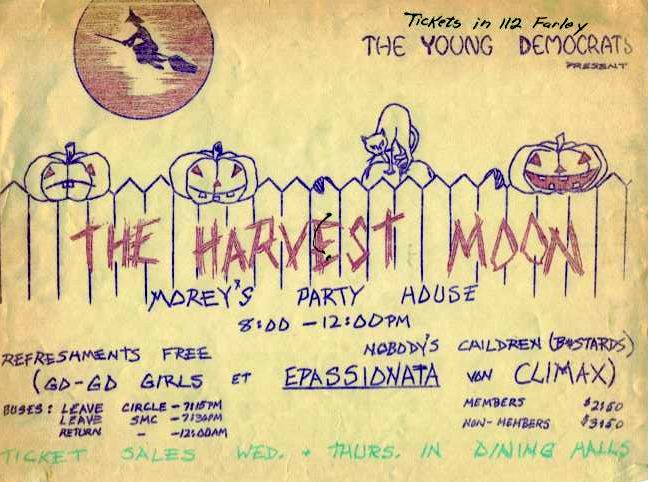
October 28, 1966 8 pm to 11:30 pm Morey’s Party House- -ND Young Democrats


October 31 1966  8:30 pm - 12:30 am Morey’s Party House --ND Detroit Club
November 4, 1966 8 pm - ? Morey’s Party House--ND New Jersey Club
November 12, 1966  8 pm- 12 am  Carriage House --ND Glee Club
January 1967--Stepan Center
Feb 17. 1967 Carriage House--ND Glee Club
March 3, 1967 8:30 pm - 12:30 am Laurel Club--ND Rugby Club
March 17, 1967  8 pm- 12 am Carriage House--ND Glee Club (green beer provided)
March 18, 1967  8 to midnight Carriage House--Farley Hall Dance and Date Party
April 8, 1967 8 -11 pm Immaculate Heart of Mary High School, Westchester, IL--IHM Student Council
April 22, 1967  8 pm - 12:30 am Laurel Club--ND Crew Club
April 29, 1967  8 pm -12:30 am  Laurel Club--ND Crew Club


Tell us more about playing in the classroom in South Bend?  Do you recall how this came about?
Peter: It wasn't a classroom except part time, I think it was a room where like the Knights of Columbus would meet. Our manager David Uhlig might remember. A gig is a gig... that one did not pay a ton. Like in The Blues Brothers, that scene where they play at the C & W road house...

Peter Herrly, "Cowboy" drummer, Roy Marshall, Jim Pino vocals, Dick Luebbe, Bill Mitsch,
 David Uhlig (manager) behind band

When did Dick Luebbe leave the band?
Bill: Dick lasted only the Nobody's Children 1966-67 season with NC’s “death" determined to be April 29, 1967 according to some documents I have.  He went on to play rough & tumble club hockey for Notre Dame.

Roy: I remember Dick wanted to play stuff like “Kind of a Drag” by the Buckinghams and “Never My Love”  by the Association. It was a little too sophisticated for my fledgling ability, but I think we all found some consensus.

Bill: We didn’t have the voices for the Association songs!


Did Nobody’s Children have any original songs?  If so, who did the songwriting?

Peter: Not really. We wanted to cover our favorites and entertain, and r&b was what we could agree on -- the Animals were big, Stones -- Roy loved the Beatles, but they are tough to replicate.  We would always discuss songs to cover, often heatedly and with passion -especially as music evolved in '67 and '68.  Our covers stayed more on the blues and rock side, but not always. We did the Animals very well!


What was the relationship like between your groups and the other campus bands like the Shamrocks, the Plague, the Shaggs or later Captain Electric and First Friday?

Peter:  Nothing for me, David James was way more into these groups and became quite the mover in those circles later (’69 and ’70, he told me).


Nobody's Children at a South Bend party spring 1967 "Cowboy," Roy Marshall, David James, Bill Mitsch
Were you aware of any of the local South Bend garage bands like the Illusions?

Peter: No. The big thing we were doing was checking out all the blues legends that were playing on the South Side in Chicago, and once in a while appearing in South Bend. Muddy Waters came to a club on the west side, unforgettable! In Chicago, we saw Howling Wolf, Lightnin’ Hopkins, Jimmy Reed, BB King... just amazing acts, before anybody but the Stones had heard about them, except the folks who went to the clubs of course.

Spring & Summer of 1967
Several members of the band were able to directly encounter the changing scene that was dawning on the West Coast.  The shift of youth culture from the Sunset Strip to the parks could be seen as a harbinger of things to come.

Peter: Roy, David James, manager David Uhlig I made a crazy road trip from South Bend to Los Angeles during spring break 1967. We were at that Easter Sunday "Love-In" at Griffith Park in March of 1967, which was fun and we also saw Lightnin’ Hopkins at the Ash Grove on that same trip.

Love-In at Griffith Park, Los Angeles on Easter Sunday, 1967- photo from Tropico Station
With the end of the 1967 spring semester, Bill headed home for a new musical experience.
Bill: I joined up with the Fantastic Emanons as their keyboard player upon returning home to Wheeling, WV for the summer break. The Fantastic Emanons ("no name" spelled backwards) were pretty good had already cut several regional hit records including “Hitch-Hike” that we played almost every night at a summer bar gig (The El Toro Lounge) we had.  We played all over the Ohio River Valley that summer.  I recall playing in Bellaire Ohio and Wheeling Park in Wheeling WV. We also practiced once on our Mitsch family front porch in suburban Wheeling that summer (2 summers before Woodstock) and a big crowd of neighborhood kids came by. It was a great event until we got busted by the Wheeling Police because some neighbors obviously complained. The good thing that came out of that is that my brother taped us with our Dad’s tape recorder.  Years later, after Dad died, we found the tape in the Mitsch home basement.  I took it to The Ohio State University audio folks and they were able to clear up a few of our songs. I have them on CD, but also on my iTunes. Every so often, the Emanons come up on my playlist as I am driving my Mustang in Ohio or Florida or sometimes on a visit back to Notre Dame.

The Fantastic Emanons-sans keyboard player Bill Mitsch

Fall 1967: The Emergence of Savage Rose
1967 saw the band at the crossroads as there were changes everywhere when they reconvened for the fall semester.  Besides what David James described in an archival email as a "heavy dependence on the Stones and Jimmy Reed material," psychedelic, soulful and heavier sounds from the likes of Blues Magoos, Young Rascals and Procol Harum seeped into their repertoire.


What was the impetus behind the band name change to Savage Rose?  

Peter: As I recall, we were kicking it around and there was a flower being tossed around. I did not want to be too flower-power, and Savage came in there – David James might have had the formulation, and David Uhlig was engaged (as a good manager should be!)


Who comprised Savage Rose?

Bill Mitsch-keyboard (Wheeling, WV)
Roy Marshall-lead guitar (Columbus, IN)
Peter Herrly-bass guitar (South Bend, IN)
David James-lead singer (Atlanta, GA)
Steve Foss-drums (Albuquerque, NM)

One of the key pieces in the evolution to Savage Rose was the inclusion of Steve Foss (class of '69), a very talented drummer fresh from a year in Innsbruck, Austria with the ND study abroad program. Prior to Notre Dame, Steve attended secondary schools in Albuquerque after a childhood of moving around the globe. The Farley Hall resident was brought into the band by David James.

Admist the alterations, their Leslie Speaker did make the transition from Nobody’s Children.

Bill: It makes an electric organ sound like a church organ as it has spinning speakers that give the wah-wah sound out of single notes and chords. It was the best thing I ever purchased, but it was a pain to haul around to gigs. It really got a workout with the Fantastic Emanons in summer 1967 as we played every night for much of the summer. 

Farley Hall, Oct. 1967, Roy Marshall, Steve Foss, David James, Leslie Speaker

The clothing choices for Savage Rose are very interesting for fall 1967 as the band appears to be wearing "working man" or "proletariat" clothes.  Am I reading too much into this or was this appearance chosen to stand out from collegiate look on campus and or the excessive psychedelic look that was in full bloom in places like Chicago?

Bill: Maybe reading too much into our clothing. We were a blue jeans group, but there was never any discussion about what we wore. We just showed up.

Was anyone the driving force or guiding force in the band as far as direction?

Bill: haha, everybody was! When David Uhlig took over, my role as record keeper and contract manager stopped.  That is why I do not have very much detail or documentation of what we did as Savage Rose.

Peter: David James took on a leading role as the lead singer, but also very good on blues harmonica.  He was also a solid rhythm guitar player who could keyboard, and was indispensable on equipment, etc.  Later David was indeed a huge force in the South Bend scene - music, Irish music also, and progressive politics. A wonderful man and a dear friend that my kids adored.

According to the aforementioned archival email from David James, Savage Rose took the stage at bygone South Bend spots and schools like Nicola's Pizza, St. Stephen's Church hall, the Mishawaka Bomb Shelter, the St. Mary's College Coffee House and the St. Mary's Academy which was on South Miami Street. The group also played at the still open Frankie's BBQ (est. 1968) and Rocco's (est. 1951). 

Spring 1968-The quintet looks over the edge of the unknown

What was the highlight musical moment for you in that era?

Roy: The Anti-Military Ball.

(The Anti-Military Ball was headlined by Phil Ochs.  It was held at the now demolished Notre Dame Fieldhouse and featured the groups Captain Electric and the Flying Lapels and Savage Rose playing under their other appellation of Indiana Joy!)

Peter: Playing at the Anti-Military Ball*... the same night that I as the commander of the Army ROTC elite spec ops unit had a date at the Military Ball. We played extremely well that night, but I had to do some magical stuff (including dumping off my date and disguising myself) to make my part happen. I did get to sing my one and only song “I'm your Hoochie Coochie Man.” At least that is how I recall it.

Savage Rose playing under their alias of Indiana Joy!
Image courtesy of Tom Wishing

* Note: "The university ROTC departments had a long-standing tradition of holding a Military Ball every spring. During the anti-Vietnam War protest movement of the late 1960s, when feelings against the Vietnam War had morphed among some into a more generalized anti-military feeling, it seemed to the protest movement at Notre Dame a fitting idea to have an Anti-Military Ball. Such was the climate in 1968." - Peter


Did the band both back Phil Ochs and play their own set at the Anti-Military Ball?

Peter: I was there for our own short set, then left as I recall to change and dance at the Military Ball, so I do believe we backed up Phil Ochs. David James would have remembered.

Bill:
it seemed like Savage Rose drifted away from me or me from it in 1968. I was at the Anti-Military Ball in 1968 (don’t remember seeing Savage Rose aka Indiana Joy! there) and ironically was still in ROTC the year before and went to the Military Ball.  One of our competitor bands borrowed my Farfisa keyboard that night and turned it up to screeching levels.  Sorry I was so generous.

The best moment I remember was in front of Farley Hall in Oct. 1967 with Roy Marshall singing a searing version of the Rolling Stones’ “Get Off Of My Cloud” and superb percussion by Steve Foss that bounced off all of the dormitory buildings on the north quad. Wish we had taped that session.


Farley Hall, Oct. 1967, Bill Mitsch, Peter Herrly, Roy Marshall, Steve Foss, David James
Steve: Seeing the Shaggs play in the basement of the LaFortune Student Center remains as one of my fondest memories of those times. It was a good place to meet girls from St. Mary's College in an informal setting.  Plus, there was dancing to a jukebox. Also should mention the Ed Sheftel Combo (from Northwestern University) at the 1966 Notre Dame Collegiate Jazz Festival (judged by Quincy Jones and Billy Taylor).  However, nothing beat the Shaggs at the student center!

Were there ever plans to record?
Peter: Maybe towards the end, glimmer of mention, with David James, our peerless vocalist, keyboard, rhythm guitar, and amp and sound man... but we never had time to get there. Roy, David, I and our manager David Uhlig all moved off campus, to the South Bend suburb Riverside no less.  Bill was very busy with his studies and David could fill in on organ -- but we were really doing more blues, and David was really pretty good at the blues harmonica.

Aftermath: War & Weddings

Bill:   I wanted to add that Leslie Organ Speaker was one of the reasons we were so good doing “Whiter Shade of Pale” by Procol Harum. That was Ruthmarie’s (Rosary College-Dominican University girl whom I charmed at Rosary’s grand piano in their lobby with Beatles and Otis Redding ballads) and my wedding march in May 1970. The band at the wedding that was permitted by a liberal Catholic Church was Dick Luebbe’s new band in Chicagoland, named Misery Loves Company.   We did not catch the irony of the band’s name for a wedding until later…Again, I better remember the date, May 28, 1970, and the place, Church of St. Leo’s, St. Paul MN. My wife’s name is Ruthmarie Hamburge Mitsch. Hitting the big 50 anniversary next year and I am sure bands will be discussed. We will try to get some old ND friends back in the fold.

Misery Love Company-May 1970-Ruthmarie Hamburge-Bill Mitsch Wedding
Dick Luebbe (originally from Nobody's Children) in white suit with red Gretsch
Steve:  After Savage Rose, I drummed with the South Bend-based Tommy and the Tornadoes led by Tom Wishing (class of '68). I also gigged with the progressive band Rotten Apple in Albuquerque.  Later, I acquired a pilot license which allowed me to fly from the Southwest to San Francisco to drum for the Tornotics comprised of Noam Cohen, Tom Wishing, his son Devin, and Johnny Augeri (class of '69).

Peter:  Afterwards the Vietnam War saw us all on very different ways, but those are other stories!

Roy: After college I got drafted into the army, spent about a year learning Vietnamese and then went AWOL to Canada for a while, came back and was put in the stockade for a while, then finally got discharged. I worked for Macy’s Parade in NY for a few years and then have been working as a carpenter/ handyman ever since and still am. I married a gal from Seattle, been here since 1980. My wife and I continue to play music together and now with our son. The Marshall Family Band; you can listen on Bandcamp. Still trying to figure out music, an endless pursuit started in Farley Hall.

Peter:  In 2017, we were invited to do a 50th reunion concert in front of Farley Hall by the young women there, but it was not to be with the musicians now located across the globe. All in all, our lives are connected to the past, and the future that we don't know.
Savage Rose-Fall 1967 Peter Herrly bass, Bill Mitsch keys, Roy Marshall guitar
While previously unexplored and largely unacknowledged, Nobody's Children & Savage Rose, can now be considered instrumental, along with foundational groups like the Shaggs, the Winds and Webster's New Word, in helping to establish Notre Dame's first musical golden age. This unpretentious group accomplished all of this by showing up to play direct, propulsive and essential rock ‘n’ roll that still stands out today.

Contributors:

Steve Foss

The Tornotics

Colonel (retired) Peter Herrly
Blue Line Films

Roy Marshall
Marshall Family Band

William J. Mitsch, Ph.D.
Director, Everglades Wetland Research Park
Eminent Scholar, College of Art & Sciences
Sproul Chair for Southwest Florida Habitat Restoration
Florida Gulf Coast University
2004 Stockholm Water Prize Laureate
Professor Emeritus, The Ohio State University

Special mention and thanks: Tom Wishing, Bernadette Netherby, RN