Sunday, September 05, 2021

Travel in the Rainbow: An Interview with Kiyo Ogami of the Fabchicks


The Fabchicks were one of the most distinct Japanese “Girls with Guitars'' groups of this century.  In sensibility and sound, they rate up with the Pebbles and Mama Guitar when it comes to all-female ‘60s inspired garage-pop-beat bands. If they had recorded more and their releases were not so obscure, they could have had the international acclaim achieved by the aforementioned bands. Still, if a Japanese band wished for American recognition and releases on U.S. labels like Get Hip, Norton, Estrus, Dionysus, Spinout, Sub Pop or SFTRI, they had to tour the entire country like Shonen Knife or the coasts like the Neatbeats from Osaka or Supersnazz and Jackie & the Cedrics from Tokyo.  Being included in a Tarantino movie like the 5.6.7.8's also does not hurt. The Fabchicks had an impeccable and strong sense of style and also well defined and refined tastes in music. Most of all, they had some of the sunniest harmonies rising from the other side of the Pacific Ocean. Their sole release Travel in the Rainbow is so extremely rare that I could not even find it at the epicenter for all things Japanese garage-Time Bomb Records in the Fabchicks’ home city of Osaka. Finding out more about the Fabchicks had been on my wish list for some time. Guitarist and vocalist Kiyo Ogami was the prime mover behind the band. She recently took the time to fill us in on her past music experiences, current endeavors and possible future explorations. 
And away we go! Growing up, tell us about your early musical experiences.  I believe you studied piano as a youngster? 

As a child, I studied electric organ for 7 years. When did you start getting into ‘60s sounds?

When I was a little girl, I used to play songs by the Beatles and the Carpenters on the electric organ. Playing these songs gave me a fondness for the hits, but I also listened to a lot of oldies. After that, I started listening to '60s garage punk music in earnest after I started playing the electric guitar in a college club.
When did you decide you wanted to form a band?
I think I was about 25 years old.  The first band I joined after my college graduation was a '70s punk style girl band. The leader of the band was into punk music, but I liked garage punk along with '70s punk, but due to little differences in musical tastes, I left the band and formed a '60s style girl band.
How did the Fabchicks form?

I scouted the drummer when she was playing in my friend's band. Except for the drummer, we met through a seeking band members flyer.

Where did the Fabchicks practice?  I imagine bands in Osaka have to rent out rehearsal rooms/practice space?

Yes, almost all bands in Osaka have to rent out rehearsal rooms. We used to practice there after work once a week.

Which type of electric guitar did you play for the Fabchicks?
My main guitar was a vintage Fender Mustang ‘68, looks cool, doesn't it?


Who designed the wonderful and colorful Fabchicks' logo? It was designed by the label owner’s friend, who worked as a professional designer

On Youtube, I recall there was an in-the-studio Fabchicks video from maybe a television show, but it is no longer there. Is this my imagination or was there once something really up like this on Youtube?
Thank you for remembering the video, even though I'd forgotten it myself. Maybe it was released as a promotion video for CD sales, but I don’t know where it is now...sorry.
Your originals “Singing Bird” and “On the Rainy Day” are standouts in that they strike a wonderful balance between the now and then with hopefulness shining through.  Would you provide any background or context on these charming Fabchicks songs? 
I wanted to make evergreen girl group songs like the ones in Sequel Records' "Here Comes the Girls" compilation series. Our songs were inspired by many less-famous girl group sounds. Travel in the Rainbow features “Treat Me Like a Lady”- an uptown pop song most associated with Lesley Gore.  There is also a frantic rendition of “Heart” which was composed by Petula Clark, Tony Hatch and Georges Aber that was also covered by the Remains and 2 of Clubs.  Yes, “Treat Me Like a Lady” was also covered by the Tages ('60s Swedish beat band). The Tages continue to impress me! What were some of the other covers performed by the Fabchicks? We also played ”Da Doo Ron Ron" / the Crystals,  “Captain of your Ship" / the Paper Dolls, “Taxman" / the Beatles, “The Train / 1910 Fruitgum Company” “Mickey" / Twinkle, “I Want You to Be My Baby / Billie Davis etc. In the later years of the Fabchicks, we also played Showa Kayo (Japanese '60’s, '70s songs) like “Yasashii Akuma" / the Candies, “Koi No Sharock /Mie Nakao etc. I recall the Fabchicks opened for the Woggles. Which other memorable bands did the Fabchicks share stages with?
We opened for the Pebbles in Kobe, I so respect them. Also, I played at an event where the Collectors (Japanese mod band) were the main act, which is also a precious memory. Do you know if the record label, Hammerkin' Production, would ever consider putting Travel in the Rainbow on Bandcamp and/or Spotify? Hmm, I don't know as that label is no longer around.

I noticed you have been playing acoustically in the last few years. It appears like you have had a good experience playing a wide variety of venues in the Kansai region.  By the way, the dashing version of Blondie’s “Heart of Glass” is really cool. Which venue (with all the interior wood framing) were your performing at?
That must be Unshudo. I played as the opening act for Sally Seltman (female singer-songwriter from Australia) a few years ago at Unshudo. The venue is small, but very atmospheric. Many musicians in Osaka love that space. In 2020, you revisited “On a Rainy Day” in which you re-recorded the song on acoustic guitar with subtle jazz embellishments. Are you moving towards jazz and jazz chords or is this all part of your repertoire? Since I started practicing acoustic guitar, I've been learning some jazz chords.
“Paisley Morning” features some elaborate fretwork on the acoustic guitar.  Sounds like you have been putting in plenty of practice time on the guitar. Now that my kids are a little older, I've started playing guitar every night. Now I'm taking a little break because I'm busy with work. You are most known for leading the Fabchicks, but you have extensive experiences with several other groups.  Would you like to elaborate on your involvement with any of these bands? The Spree (Guitar) the Cleabs (Drums) the Boogies (Drums) Woman Jacket, the NGI Girls (Vocals). The Spree is the aforementioned '70s punk band. I was in the band as lead guitarist. In the Cleabs, I started playing drums as a support drummer. They played '60s psych/garage punk/freakbeat-inspired original songs. I'm also currently playing drums in a band called the Boogies. I recall the Boogies is a ‘70s rock power trio and the Cleabs had the leadoff song on the Hammerkin' A Go! Go! compilation.  The NGI Girls is your trio that has the look and sound of the Supremes and the Three Degrees. How did the NGI Girls come about?  It appears like this trio is very well received by audiences! When my little girl was only two years old, I asked my friends I met at a parent-child gospel circle to help me form the NGI Girls. I've always wanted to sing in a Motown style girl group that sings without instruments. 
The NGI Girls

Are any of the other former Fabchicks members still involved with music that you know of?
The other members still have small children and are busy raising them, so they are not active in music at the moment. Where do you see your music going in the future? When the Corona disaster is over, I want to revive my guitar playing and the NGI Girls activities again! And I want to write songs like Susanna Hoffs, which are based on many shared influences. What are some concepts that you have learned from being in a band that you are able to apply to work and/or life? That's a bit tough question…being unshakable, maybe.

Favorite current Japanese bands and/or musicians?  


After I started playing the acoustic guitar, I’ve been mainly listening to acoustic guitarists' music like Yuichi Ohata, Mari Nakamura, etc. They are great guitar players.

What are some Japanese records, from any era, that you would recommend?  I know you have previously expressed how the Pebbles were a major influence for the Fabchicksl   Actually, I don't listen to much Japanese indie music nowadays. However, I really recommend the Pebbles, as you mentioned. Each member of the band is so talented. I also listen to a lot of old Japanese music like Happy End, Eiichi Otaki, Pico and other Showa-Kayo songs and Group Sounds (GS) recordings. I bascially like foreign music, so I like Japanese songs that are based on foreign music.


The Golden Cups are one of my best recommendation in Japanese GS (Group Sounds). Take a listen to their original “This Bad Girl." Its rough fuzz guitar sound is so cool!
         

Here’s my other recommendation Happy End’s 1973 album and one of the most important bands in “City Pop,” the latest music trend in the world
What have you been listening to lately? Margo Guryan, Judee Sill, Molly Tuttle, Susanna Hoffs etc. I post them as now-playing on my instagram account.


Favorite ‘60s Girl Groups?  The Ronettes, the Supremes, Shangri-Las, Martha and the Vandellas, the Paper Dolls, the Breakaways etc.


Favorite Girls with Guitars groups? The Runaways, Nicki and the Corvettes, the Pleasure Seekers and other lesser-known bands found on the “Girls In The Garage" compilations.

What are the most inspiring parts of being a musician?
To be able to interact with many music lovers. On the other side, the most disappointing parts of being involved in music? Not much, but if I had to say, there will always be people who criticize other people's music. What are some of the challenges of being a musician in this 21st century? Be strong in technology lol

What makes music so important in your life? Something I can pursue through a lifetime. Did you live in Beijing at one point in your life?

Yes, after I graduated from university, I studied Chinese there for one year.

I also took my guitar with me to Beijing.

Friday, July 30, 2021

Tokyo Junkie by Robert Whiting


Tokyo Junkie: 60 Years of Bright Lights and Back Alleys...and Baseball is truth in advertising as it’s a memoir mostly of Tokyo from a bygone era-roughly the early ‘60s through the ‘80s bubble. Whiting does later enter the realm of the 21st century and provides coverage of the 2011 Tōhoku earthquake and tsunami, Covid-19 and the predicaments of hosting the 2020/1 Olympics. Early on, Whiting seems about on target with his insight “...the Japanese already have their own religion: Japan and the idea of being Japanese.” As a writer, he is most of all a journalist, and he frequently writes in broad strokes. Without the singular focus of his two most notable books which examined the Tokyo underworld and Japanese baseball, this one is more ramshackle, but certainly more heartfelt, homespun and obviously personal.


With Tokyo being so highly advanced on many levels, it’s hard to reconcile the prevailing thought during the time of his arrival in early ‘60s Tokyo that the city was sadly considered a backwater (by deployed American clergy and military factions). However, I appreciated learning more about Sophia University as Whiting fondly recounts his time studying there and connecting him to work opportunities (i.e., English teaching) in the rapidly rising, expanding and multi-layered city. Whiting writes with appreciation on how Tokyo formed him for the better after leaving the limiting environment of Eureka, CA and the regimentation of the Air Force. He also exhibits the spirit of adventure and curiosity that was embodied by the late Anthony Bourdain who he mentions as a symbolic fellow traveler. Days turn to decades in Japan and Whiting further elaborates on what he thought propelled the Japanese during the formative era of Tokyo as he cites their inspiring effort, determination, honesty and Gaman. (I was not previously aware of Japan’s women's volleyball team defeating the Soviet Union for the Gold at the 1964 Tokyo Olympic Games.) He also ventures deep into the Yakuza underworld and their lucrative connections to Tokyo construction, supposedly based on planned obsolescence, and by turn corrupt and entrenched politics.

His smattering of recollections range from “had to be there” moments to the distinctive experiences regarding the overall rise of Tokyo to what many consider (including myself) as the most exciting and preeminent city in the world (with Osaka being a close runner-up). Whiting’s mention of the “abundant hydrangeas” in the early summer evoked memories for me of being in Japan for the first time. He even details the rockabillys in Shibuya’s Yoyogi Park which were featured in Wim Wenders’ documentary Tokyo-Ga. The architecture of Kenzo Tange, former New York Yankee and good guy Roy White who made the effort to learn the language and Ayumi Ishida, singer of Nippon standard “Blue Light Yokohama,” all make appearances in Whiting’s first-hand accounts.

Like most of East Asia in this century, there is a palpable excitement and optimism about the future in Tokyo which stands in marked contrast to the repetitive and perfunctory patterns found in the United States. As a dynamic megacity which challenges attempts at comprehension, Whiting understands that Tokyo needs to be ever-evolving into something it has never been before. Still, many doubted how Tokyo was going to feasibly conduct the Summer Olympics and Paralympics even before Covid-19. Without general spectators, things will be done much differently than attempts to reach the sky high standards set by Beijing in 2008. Facing another seemingly insurmountable challenge, Tokyo and the Japanese will once again characteristically rise to the occasion with Wa and go well beyond expectations.


Thursday, July 22, 2021

Minari-Original Motion Picture Soundtrack-Music by Emile Mosseri


Upon initial viewing of Minari, I quickly noticed the atmospheric sound that has become somewhat characteristic of A24 Films (Lady Bird, The Farewell). However there was something more musically implicit that was taking place beyond the foreground screen and speakers. In moments, the sounds swept and rose to express an impressive range, while also being emotionally evocative. Behind all this is multi-instrumentalist Emile Mosseri, who had his breakthrough with scoring The Last Black Man in San Francisco in 2019. His appealing songs, composed upon piano, are embellished with a 40-piece string orchestra outsourced from Macedonia and rounded off by wordless vocals. The soundtrack encapsulates and conveys the shifting vicissitudes of the Korean immigrant Yi family in their attempt of establishing a family farm in Arkansas during the pre-Farm Aid eighties. 


Writing the score from Lee Isaac Chung’s script allowed Mosseri to stretch out without preconceived notions. With this process, the score takes on its own unpredictable and unexpected identity, while also fitting the film. The music expresses the theme of eeking out a livelihood hinged upon the precariousness of nature against a constantly fluctuating agrarian economy-along with a sub-theme of the variegated roles of religion in both Korean-American and Southern cultures. It could even be maintained that Mosseri’s score even carries and propels the film. The soundtrack also achieves a balance of presenting an overall sound alongside standout individual pieces-thus clearing the common trapping of soundtracks becoming nondescript after the main theme (in order to serve the film). This concision and definition could be partly attributed to Mosseri’s extensive background in rock and pop.


Farm to Turntable

“Garden of Eden” has almost an exotica quality and is presented with a lushness that belies the quotidian and incessant demands of tending to the earth. Sung in Korean by lead actress Han Ye Ri, “Rain Song” is an invocation to mother nature to summon the life-giving rains. These spacious songs offer bucolic hope, while confronting the deeply entrenched economic patterns and a hardscrabble land with a sense of determination. This musical encapsulation of hardship and hope is fitting for a film which presents a countervailing take on the prevailing diaspora narrative of East Asian/Korean settlement along the coasts.

 
International Harvester

The stately “Big Country” and hushed “Jacob’s Prayer” are at times evocative of early Sufjan Stevens-if not the maestro himself Ennio Morricone. As heard on the trailer, the stirring “Birdslingers” enters with a bold marching cadence and wordless vocals which effectively conveys the dramatic elements of the film with verve before yielding to an extended piano outro. This most inherently grounded piece also presents Mosseri’s most memorable melody of the soundtrack. With ethereal echoes of “Watermark”-era Enya, Kim Jung Mi, and even Joe Meek, “The Wind Song” is sung in Korean by the aforementioned Han Ye Ri and unfolds in wide-open naturalistic fashion while being carried along by a detuned 1943 Gibson L-2 acoustic and wavering theremin-like gusts generated by a 1984 Korg Monopoly synthesizer. The soundtrack succeeds both at expressing the fuzzy, jumbled and blurred-around-the-edges impressionistic nature of childhood memories along with the shifting concepts of settlement & transience and embracing the foreign and the familiar. At times, Mosseri’s otherworldly score transcends its liminal space & time to connect the temporal and repetitive with the elusive eternal.  Overall, this recording elevates and establishes Mosseri as one of the most adept and striking film composers currently working in the field.


Sunday, June 20, 2021

Yeongene – Bonnie Gene : Yeongene In Scotland


Korean singer Yeongene and Duglas T. Stewart of Scotland’s BMX Bandits are a match made in musical heaven as they combine forces to present the music of the American maestro and living legend Burt Bacharach. Besides the aforementioned Stewart, 왕연진 Yeongene Wang is also backed instrumentally by a host of top-tier Scottish musicians like Stevie Jackson (Belle & Sebastian), Gabriel Telerman (the Pearlfishers), Eugene Kelly (the Vaselines), topped off by backing vocals from Norman Blake (Teenage Fanclub) and arrangements & engineering by David Scott (the Pearlfishers). This 2010 collection from Glasgow’s PoppyDisc combines two stellar releases, which were previously individually released in 2006 by Beatball Music in Korea. PoppyDisc partitions the collection into two chapters with Chapter One being Me & My Burt, the aforementioned Burt Bacharach songbook project, aptly followed by Chapter Two which is the Saveoursmiles release from Yeongene Vs BMX Bandits. The streamlined beauty of this release is that it gathers together all of Yeongene’s music with BMX Bandits in one complete package.

Chapter One - Me & My Burt (A Burt Bacharach Songbook) 

The soundtrack for Lost Horizon is as infamous as the 1973 box-office failure it accompanied in that it completely severed the once-inseparable musical partnership between lyricist Hal David and Bacharach. The fiasco also damaged Burt’s working relationship with Dionne Warwick to further rub salt in the wound. In any case, Yeongene’s elegant rendition of the main theme fares much better than hirsute folkie Shawn Phillips as her voice is perfectly suited to interpreting the layered lushness of the Bacharach songbook. Yeongene is also certainly up to the musical task of traversing the shifting time signatures and intricacies which place Bacharach compositions in a class of their own.
Accomplished
Yeongene had decades of musical experience to prepare for these releases. After years of piano study, Yeongene joined the Korean indie-pop outfit Linus’ Blanket in 2001 on a holiday lark. In time, she came to lead the group before eventually recording solo under the name. While gentle guitar-driven indie-pop with jazz accents was Linus’ Blanket’s forte (and perfect for H Mart background music), her sound began to swing in more ragtime and jazz age directions in the subsequent years before further expanding and diversifying into even more styles. Nonetheless, the versatile Yeongene is said to be a prodigy who can play back a song on a keyboard right after hearing it.
Sturm und Drang
Next, Yeongene turns to “Tower of Strength,” an early Bacharach collaboration with lyricist Bob Hilliard, that would go on to be Gene McDaniels’ second biggest hit behind his signature song "A Hundred Pounds of Clay.” Yeongene delivers the song with a plea for the necessary strength to withstand the burn of being spurned. “Wives and Lovers” has been a long-time favorite with the jazz set and here it is delivered with a major nod to Brubeck's tugging “Take 5,” while Yeongene incants “Time to Get Ready for Love” like Ranny Sinclair. With Yeongene’s voice providing the requisite soft touch, the effervescent “I’ll Never Fall in Love Again” is the first of the indisputable Bacharachian standards that will have you humming it for days.

Vegas Vernacular I was previously familiar with “It Doesn’t Matter Any More” by the Cyrkle from their Neon album.  The inclusion of a pronounced 12-string guitar and bump-a-bump-bah's in the middle eight are especially fitting touches heard on Yeongene’s version in which her vocals are seemingly layered over BMX Bandits’ backing track for their contribution to Big Deal’s 1998 Burt Bacharach tribute album. “Try to See it My Way,” would make a perfect placement in a Korea drama. Its jazzy guitar flourishes and a sax solo add embellishments that were not present on previous versions by Joannie Sommers and Peggy March. “Promise Her Anything” will have you recalling the ultra-swank Tom Jones version that would sound best in Las Vegas at the Monte Carlo late night show. In contrast, Yeongene’s rendition would perfectly blend into the sunlit confines of a natural wood coffee bar of the imagination or even the Peppermill Coffee Shop & Lounge up on Las Vegas Blvd. Growing up in the ‘70s, I didn’t think I ever wished to hear the shopworn evergreen “Raindrops Keep Falling on My Head” ever again, then I heard Yeongene’s buoyant interpretation that is light on its feet with her adept handling of the fluid tempo change in the jaunty outro. Her voice goes along with the music like water and a slide. Overall, Yeongene’s vocals are well attuned and suited to the sounds of the heartfelt Scottish pop like Dionne Warwick’s elegant voicings fell perfectly in place interpreting the daunting compositions & arrangements of Bacharach and expressing the lyrics of Hal David.

Peppermill Coffee Shop & Lounge 
Las Vegas, NV

Chapter Two - Yeongene Vs BMX Bandits

Chapter 2 begins after the intermission of “Jean,” a wistful Rod McKuen composition and like 1957’s “Tammy” by Debbie Reynolds, it shares the characteristics of being a 3/4 ballad and a movie theme titled after the main female protagonist. The poptastic “Do You Really Love Me,” is delivered in Midwestern mid-sixties pop style (i.e.,Tommy James and the Shondells, the McCoys). The song is testament that this was songwriter Daniel Johnson’s finest moment as he brilliantly gets to the heart of the matter with a catchy song that will plant a smile on your face in the face of uncertainty. The lightheartedness of “Ally Ally Oxen Free,” another Rod McKuen composition, reminds me of Death by Chocolate’s cover of “If You Want to Sing Out Sing Out,” from film Harold and Maude. “Come on Out and Play” is a total bubblegum TV theme song replete with a bouncy bass and a modulation that will put a spring in your step.


Isn't She Great?
Sometimes it takes the combined efforts of a Korean and several Scots to reapproach and recast some of the finest sophisticated pop songs in American music. I hope they will consider another volume as the possibilities are vast. How about choice selections from totally ignored Together? and Isn't She Great? soundtracks? What about the schlock of “Arthur’s Theme” (Best That You Can Do) or the mighty MOR of “Something Big,” which briefly cracked the top 40 in 1971 for Mark Lindsay? Moreover, one can never go wrong with his ‘60s songs like “Reach Out for Me,“ the Pitney pairing of ”24 Hours From Tulsa,” “The Man Who Shot Liberty Valance” or the towering peak-era centerpieces “The Look of Love, “The Windows of the World.” and “What the World Needs Now Is Love.” This shining hour is recommended for those who like Scottish pop, Rod McKuen, K-pop, and/or Burt Bacharach, which should just about cover everyone by this point.


Orange Paw

All signs and signifiers point in the direction for this to be an overall good listening experience where you stream a few times while you take in the mountainous graphic design motif and contemplate the use of uppercase 1995 typewriter font for the band’s name and album title before striking out to explore other sounds. However, the unanticipated chords and halting melodies entice one to “stay awhile” longer and absorb the sonic waves stretching out to the horizon. Orange Paw is a solo effort from Mara Williams who is best known for being a member of Melbourne's Pink Tiles. While the overall sound, coated with abundant echo, contains aspects of what was once called noise pop or crash pop, there is an entrancing intangible quality which slopes towards the Aislers Set or the Mountain Rock of Dear Nora. Further, the fidelity might be so low that you can hear the interceding fan of a 2006 laptop in it, yet these ambient parts add up to be part of the greater cohesive whole.
Listeners are lead through the loops and leaps of uneven emotional terrain on "D D D Dorothy" with its ascending and descending melodies lightly wound around surefooted chords and reassuring harmonies in the air. The jaunty “Runaway” is an instrumental gem that stands on the shoulders of giants like “Sacramento” by Heavenly with a dash of the Dunedin sound. Picking up the pace is “Alejandro” and in the hands of a full band, this could be a surging Tra La La song and touted by Shredding Paper (if that outstanding zine was still around).

"Karoke Song” (Song for Raj) heads into to Yea-Ming & the Rumours territory where sparkling night skies are highlighted by falling stars of steel guitar and "Love is Love" by Culture Club plays off in the distance from a transistor radio. “Rockbeare Park” features Tiger Trap crossing paths with the Carpenters, Bread, and the Shirelles. The moody minor key melodies comprising the verses of “Real Big Kid” reminds me of “I Won’t Be the Same Without Her” (composed by Goffin & King and recorded by the Warner Brothers and the Monkees) before heading into an insouciant sounding chorus along the lines of that dog or Dressy Bessy. Throughout Orange Paw, Mara Williams delivers her melodic sensibilities in strong, sure and swift strokes which catch the light through the shifting dynamics and dimensions of Melbourne’s coastal haze.

Saturday, June 05, 2021

Chandler, Arizona's First Outdoor "Band Concert" (1969)

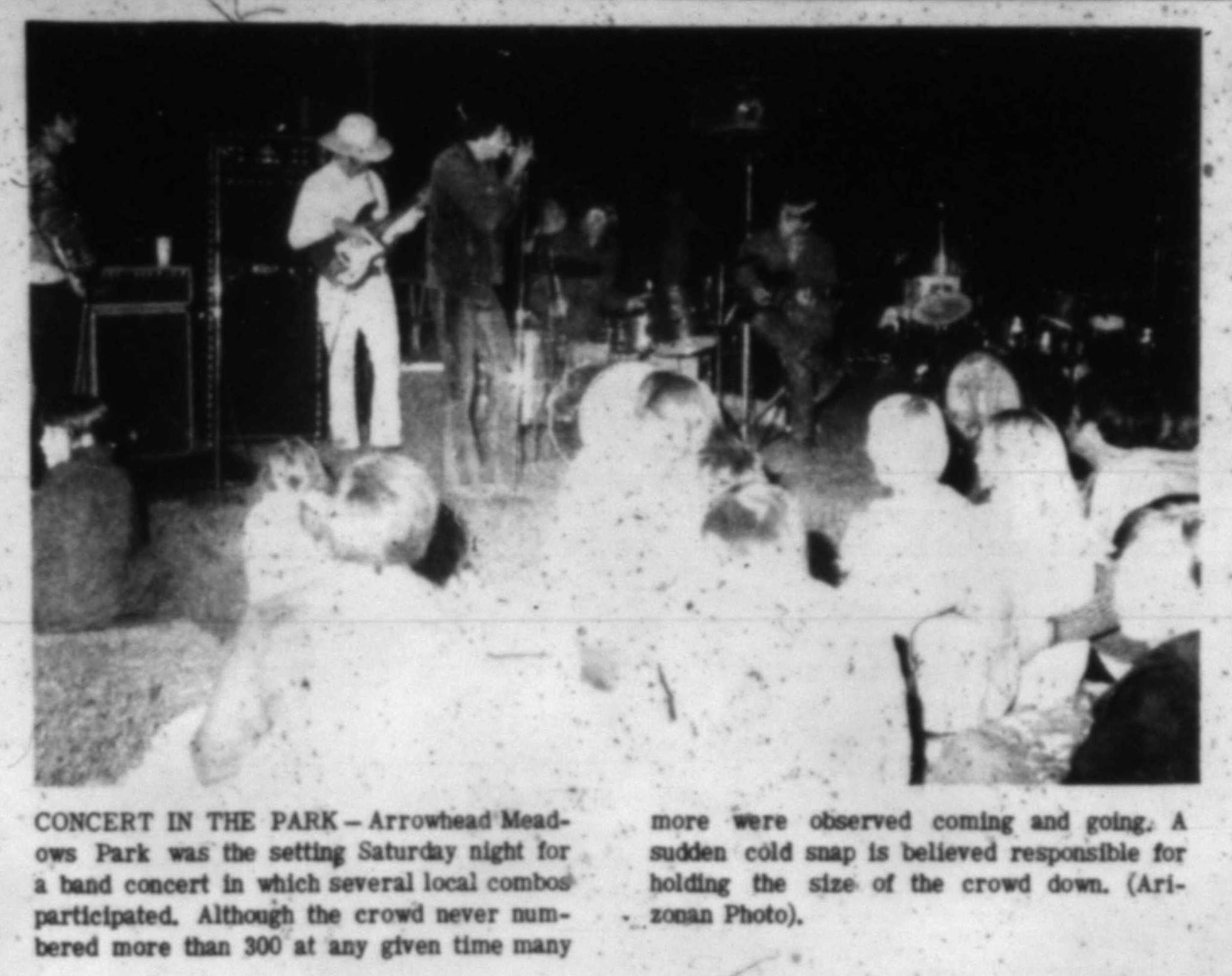
In 2017, I came across a blurry image and brief encapsulation of an October 1969 concert held in
Arrowhead Meadows Park in a microfilm edition of the Chandler Arizonan. This seemingly unlikely event compelled further exploration. Was this just the thrilling tip of the iceberg which would lead to the discovery and documentation of additional local bands or merely a blip in history where the world has simply moved on?  Life did move along and contacting the coordinators mentioned in the preview blurb had been something I wanted to follow up on. After some initial research spurred by all the Seton Catholic yearbooks going online, I was able to connect to all three of the organizers. In turn, I heard first-hand accounts about a much different small town-ish Chandler (population est.12,000) where friendships were initially formed and forged over the side streets, sidewalks and granite-hard soil framing the Hartford subdivision.
 
It appears that the Chandler Arizonan newspaper got the date wrong as Oct. 14 would have been a Tuesday night in 1969. 
Enter the Young

A group of friends, Alvin Koppinger (Seton Catholic, class of ‘67), Michael Walsh (Seton Catholic, class of ‘67) and Jim Yontz (Chandler High, class of ‘68), spearheaded Chandler’s first outdoor rock concert.  If NASA could put a man on the moon just a few months before, an intrepid group of students who were all attending universities and colleges (Arizona State University & Mesa Community College), close to home could enact and realize their vision of an outdoor rock concert. “There wasn’t a lot going on at that time in regards to music in Chandler,” remembers co-coordinator Alvin Koppinger.  “We wanted to make something happen.”  When asked who came up with the notion, Michael Walsh called it, “A group idea and collaborative effort.” 


600 N. Hartford St.
 This 1968 sign has been unfortunately removed in the last few years.
 Photo by Holly Metz of Six Palms Studio.


Cowboy Haven
Besides being a “cowboy haven” according to Jim Yontz, Chandler was a law & order town back then that had the tendency to be complacent on many fronts. Michael Walsh’s recollections took on a more cinematic quality and said the dusty area and atmosphere were similar to the period piece encapsulated in American Graffiti which reflected George Lucas’ experiences growing up in Modesto in California’s Central Valley. For Alvin, who moved to Chandler from North Dakota in his early teens, Chandler was cosmopolitan in comparison. “I remember it was a big deal to go to the Golden Peacock Chinese restaurant on Arizona Avenue,” mentions Alvin Koppinger. “In North Dakota it was strictly meat and potatoes.” In that (pre-Intel) time, Chandler was a Future Farmers of America town (aka the backbone of a nation), so the local Ford dealer probably sold more tractors than cars...at least more pickups than cars. 

Still Chandler, a redlined town, was far from being a live and let live frontierland in the ‘60s as there were also recollections of observed deep seated intolerance and provincialism which unfortunately and sadly continues to persist and frequently flare up anywhere in America to this day. Alvin mentioned that the circles he ran in did not have any issues: “I played basketball for Seton and sometimes we would play pick-up games on the southside.” “The shared experience and camaraderie brought us together. It was mainly the older generations that were entrenched in their ways.”


Setting the Stage

Way before musical liftoff, there was the planning phase and painstaking approval process to obtain a permit. “One of the biggest challenges was getting the approval and permit to put this on at Arrowhead Park,” recalls co-coordinator Alvin Koppinger. “I had to go up in front of the City Council and the director of Parks & Recreation was absolutely against it.” As with many situations, going through the obstacles was the way forward. However, the resolute organizers did not back down despite the fact that the ultimate outcome hung in balance on the council’s decision. “Alvin did a masterful job of going up in front of the City Council and rebutting their arguments against providing a permit for the event,” conveys Yontz.  “He was so well prepared and even had charts & graphs and a pointer to support our objectives and grandiose ideas.” 


Working within the Parameters At the time, Arrowhead Meadows Park was considered to be somewhat on the outskirts of town and hosting countercultural musical concerts was not exactly a prioritization, let alone even a consideration for the park. The City of Chandler reportedly had built Arrowhead Meadows Park on Erie Street in the early ‘60s to potentially attract a Cactus League Spring Training MLB baseball team like nearby Casa Grande (San Francisco Giants) and Mesa (Chicago Cubs). The Houston Colt 45s (later to become the Astros) were close to coming to Chandler in 1964, but negotiations broke down as the Houstonians declared the infrastructure was not up to par. Parks & Recreation used similar tactics against what they saw as the folly of youth. “They (Parks & Rec) cited the lack of restrooms and parking as their reasons against the event,” continues Yontz. “It was only a few months after Woodstock took place and the City was worried things could quickly spiral out of control in similar fashion.” “Harm to new trees,” “possible abuse of playground equipment” and “parking control” were a few of several concerns expressed by the Park & Recreation director as documented in the City Council minutes from Sept. 25, 1969. In retrospect, damaging new trees would not seem like it would be a high priority for the target audience of hippies, wanna-be hippies and students. The notes further revealed the three young men agreed to meet with the Parks & Recreation Director and the City Manager to “work out details.”  In what seems like a turning point from a movie, their request for permission to use Arrowhead Meadows Park for a free concert open to the public was carried unanimously.  To the city’s credit, it was more than fair to give this consideration, opportunity and responsibility to its young residents. 

Chandler City Council Meeting 9-25-1969 minutes courtesy of Chandler's City Clerk's Office


No Turning Back

With the approval, the organizing trio were able to quickly set things in motion.  “We had flyers made up and we posted them at Mesa Community College and Arizona State University,” recalls Yontz. “We honestly didn’t know how many people were going to attend our event.” While the first and most difficult obstacle was cleared in obtaining a permit, there were further challenges to overcome-some previously mentioned by the Parks & Rec. director. “Getting power out to the stage for the lighting, instruments, sound board and amplification did prove difficult,” explains Koppinger. “As far as seating, we were able to use some of the bleachers in the park.”  When asked about which bands played that night their memories are as fuzzy as the newspaper clippings from that era. Alvin recalled the acts were all local, meaning Chandler and some crossover from Tempe with musicians like Mike Ash who doubled duty on keyboards and operating the sound board. All three mentioned that the talented and versatile Chandler musician Dennis Schroeder (singer in photo, next to the hat wearing Mike Love-looking guitarist) was heavily involved. Alvin added that many of the musicians switched out instruments and played in different configurations that night. Dennis Schroeder (Chandler High, class of ‘67) does look like a pro musician in a ‘66 Sunset Strip/Sky Saxon way and there was a reason for his appearance. “His mother made him those hip clothes,” notes Yontz. “Dennis had the courage to wear them everyday in a place that was not accepting of this look.”  Overall, attendance topped out at about 300 people according to the newspaper caption, which the organizers confirmed as “probably about right.”


Supplanting the Sugar Plant

Agriculture, with a concentration in cotton and citrus, was the major industry of the time.

In 1967, Speckles Sugar Company opened a massive and “modern” processing/refining plant on Riggs Road. The plant which processed the sugar beets grown by area ranchers into sugar and syrups ran 24-hours a day. “At the time, there was great excitement about the opening of Spreckels because of the jobs it would provide for those in the area,” recounts Jim Yontz. “Even some of the Chandler teachers worked there to supplement their income.” However, working conditions proved to be Dickensian, if not downright brutal.  Alvin, Jim and Michael all spent time working at this mostly unregulated and dangerous operation during their summer breaks. These experiences stood in great contrast to their stints working in the bucolic citrus grooves of Habeeb Citrus Growers in Mesa and motoring around on tractors. According to Jim Yontz, Habeeb were renowned for their grapefruits that were grown to be sold in Southern California’s upscale grocery stores.   


Jim and Mike also worked at one of Bashas’ initial supermarkets in a chain which grew exponentially in Arizona during the ‘60s. Incidentally, both Basha and Habeeb were businesses founded by the area’s Lebanese pioneers who settled in the area after initial forays in mining towns like Ray (birthplace of Ianthe McGuinn, former wife of Roger McGuinn of the Byrds) and Sonara (birthplace of Latin Jazz musician Bobby Montez).  These mining towns, located in the adjoining Pinal County, ultimately did not pan out and have long since vanished. Ultimately, profit margins for liquidfied sugar never solidified and the Spreckles Sugar plant closed in 1984. Hopes for a thriving economy in Chandler would have to wait out the fallow period until the transition into technology. 

Circuit-Board Flat High tech arrived in the wide open Southwest when the Rogers Corporation opened their Circuit Systems Division in 1967. Rogers emerged to become the leading manufacturer of circuit boards. In 1980, Intel expanded into Chandler and eventually became the city’s largest employer with an estimated 12,000 employees.  The arrival of Intel marked the ascendancy of technology for Chandler along with further diversifying its population, while enhancing multiculturalism.  These developments would start the physical transformation of Chandler from crop, cattle and sheep fields to server farms, semiconductors, self-driving cars and smooth roads. Today nearly an estimated 270,000 residents call Chandler their home.


The Sky's the Limit
While it may not be monumental in the grand scheme of Arizona music history-especially compared to the Easter 1967 Love-In at Tempe Beach Park, it was meaningful within the local context. Over 50 years later, this event has the distinction of being the first outdoor music concert featuring electrified rock ‘n’ roll in Chandler. It also could be considered a harbinger as the Chandler Jazz festival later took place at Arrowhead during the ‘80s. In 1985, Compadre Stadium, 5 miles to the south of Arrowhead, was built to become the spring training home of the Milwaukee Brewers (1986-1997). This now demolished stadium would subsequently be notable for hosting 1990’s KUKQ Q Fest featuring the Dead Milkmen and KUKQ birthday bash in 1991, headlined by the Feelies. More recently, Chandler’s Veterans Oasis Park and Environmental Education Center has hosted the Sonoran Sunset Music Series of free outdoor concerts. While the names of the bands from 1969 may be completely dissolved from memory, the singular event could stand in and represent those things that have disappeared in the farm fields and parks between the antenna lights of South Mountain and State Route 87.
1974 aerial view of Arrowhead Meadows Park
Photograph courtesy of the Chandler Museum
Castles in the Air Behind and beyond this autumnal moment at the end of the ‘60s was the determined idealism of a group of young Arizonans who brought it to fruition over the swirling undercurrents and tensions of the times. To quote Henry David Thoreau: “If you have built castles in the air, your work need not be lost; there is where they should be. Now put foundations under them.” They were not only able to place a foundation under the castles; they helped lay the cultural groundwork. Today, they are still in contact and went on to change the world for the better in their professional pursuits. Alvin Koppinger is a retired elementary teacher residing in Colorado who started his teaching career at Chandler Unified School District (CUSD). Jim Yontz is a speech pathologist in Phoenix who operates a bilingual practice with a focus on “speech therapy delivery to developmentally and intellectually disabled children and adults.” Michael Walsh found his calling with a high tech career in Albuquerque, NM. Not only did this inspiring trio make their own paths starting in Chandler, they also initiated change, brought music to the public forefront and forged a lifelong bond along the way.

Acknowledgements: Nate Meyers of the Chandler Museum for the aerial photograph of Arrowhead, Holly Metz of Six Palms Studio for use of her Kwik-Kleen photograph.

Friday, May 21, 2021

Baja Bug-The Surf Will Rise Again!

The Scandinavians have become the standard-bearers for excellence when it comes to instrumental and surf sounds made in the 21th century.  For instance, the Swedish combo the Surfites have led the line-up when it comes to releasing instrumental albums which stand up as giants of the genre. Perhaps this development can be traced back to the immense popularity of the Shadows and Spotnicks in the Nordic region during the ‘60s. Still, these Scandinavians combos tend to lean towards the Southern Californian ‘60s surf sounds instead of the aforementioned European instro sounds and/or the Rautalanka sound of nearby Finland.  In the last few years, another Scandinavian outfit with the very Golden State name of Baja Bug has emerged from Olso, Norway blazing along with a sound that could be coined “Dune Buggy Rock.” Baja Bug seems reminiscent at times of the liminal scene and sound that blipped between the second wave surf revival of the early '80s and the third wave cursed and blessed by Pulp Fiction.  It was a time when bands like the Dragsters (from New Jersey) truly stood out in the late ‘80s sea of metal with their image, iconography and inspired choice to cover “Maria” from West Side Story. This record starts with some indistinguishable spooky surf, although “Zombies on Surfboards” does seem to cleverly quote from “Interstellar Overdrive.”  Baja Bug finds its footing on the fourth song in with “Moose on the Loose.” The immediate song sparkles with surging melodic runs and a whirling organ overlapping to achieve a perfectly balanced alignment. They also separate themselves from the pack of bands who sound totally removed from the elements of surfing itself. The power and glory of the Pacific Ocean, the rolling lift of catching a wave and traversing towards the wraparound shore are all captured and sonically expressed. For instance, “Gunfight in Kreml” features a dashing Russian folk melody and a tubular arrangement which evokes that fleeting feeling (or pipedream) of riding in the barrel. The sweeping Southwestern sound of “Moehawk” appears over the desert horizon with twang and menace recalling the wide-screen sounds of the Hellbenders. “Pacific Punch” could be the group’s signature song as it's the most quintessential Baja Californian or Coloradoan as it echoes the Astronauts-motoring along boulders of bright melodies and maintaining traction with its underneath churning percussion. The addition of a roll bar of guitars expands the song to the wide-open West where mountains, ocean, sun and sand converge. Baja Bug is making a run for being the world’s best and only current dune buggy rock band. Hopefully, more groups will follow in its tracks. 


Saturday, March 20, 2021

Las Siete Potencias – Smokin'

It’s hard to know just how many Latin bands formed In the wake of the film Our Latin ThingIt could be stated, that this gritty, yet celebratory film had a similar catalyzing effect that A Hard Day’s Night had on the kids out in the Anglo neighborhoods.  It’s quite possible that Las Siete Potencias (the Seven Powers) were set in motion by this 1972 cinéma vérité documentary. This Bronx band was led by the versatile Louis Sanchez on vibraphone, who composed and arranged the majority of these songs that are not merely Smokin’, but are a sizzling wildfire of polyrhythmic proficiency. Sanchez clearly demonstrates that he was the prime mover and creative force behind this vibraphone driven Latin Jazz which incorporates salsa, pachanga with shades of exotica. The opener “Los Seneros” may seem like standard-issue salsa upon initial listening, but additional listen reveals the subtleties and a summoning to dance. “Free Wind” sweeps in like “Flute Thing” by the Blues Project that the Beastie Boys would sample on their “Flute Loop.” Ricardo Marrero, the co-producer of this album and who is still going strong, plays the stately piano melody on "Speak Like a Child." Vocals and instrumentation converge into a seamless whole on “La Juventude De Chango'' and are reinforced by the band’s strength of not sacrificing melody for the sake of rhythm. This 1976 album, released by Tito Rodríguez's TR Records, ends on an extremely strong note with two cosmopolitan instrumentals. “The Continental” features snap and crack percussion with dashing vibes that joyfully kick into gear to reach a panoramic crescendo. “Las Siete Potencias Theme/“Green Dolphin Street” sounds like a theme for an ‘60s international espionage flick, but with a tropical twist of the sun breaking through. Smokin’ not only stands up as a stellar seventies salsa album, but the skillful arrangements allow the songs to stretch out and radiate some vibrant edged exotica in the realms of Afro Blossom West by the Andre Tanker Five and Percussionata by Monte Moya & The Surfers. In addition, the top quality recording captures the percolating propulsive elements along with shifting layers of subtle touches. Overall, the incendiary Smokin’ continues to excite and endure as it's tuned to Bronx ‘76, while emanating a lasting glow.